
Blog
July 6, 2026
Fighting Federal Overreach to Protect Transgender Health Care
GLAD Law is leading efforts to stop the Trump administration’s weaponization of the federal government against transgender Americans, including attacks on their access to health care. The administration is threatening to limit transgender health care access through federal rules and funding mechanisms, and is trying to force hospitals to turn over private medical records. These actions have created chronic uncertainty and fear for patients, families, and providers alike.
These actions exceed executive authority and violate constitutional and statutory protections. GLAD Law, our legal partners, transgender people and their families, states, medical associations, and others are challenging this overreach by the federal government and fighting to protect transgender people’s health and safety and defend medical privacy for everyone.
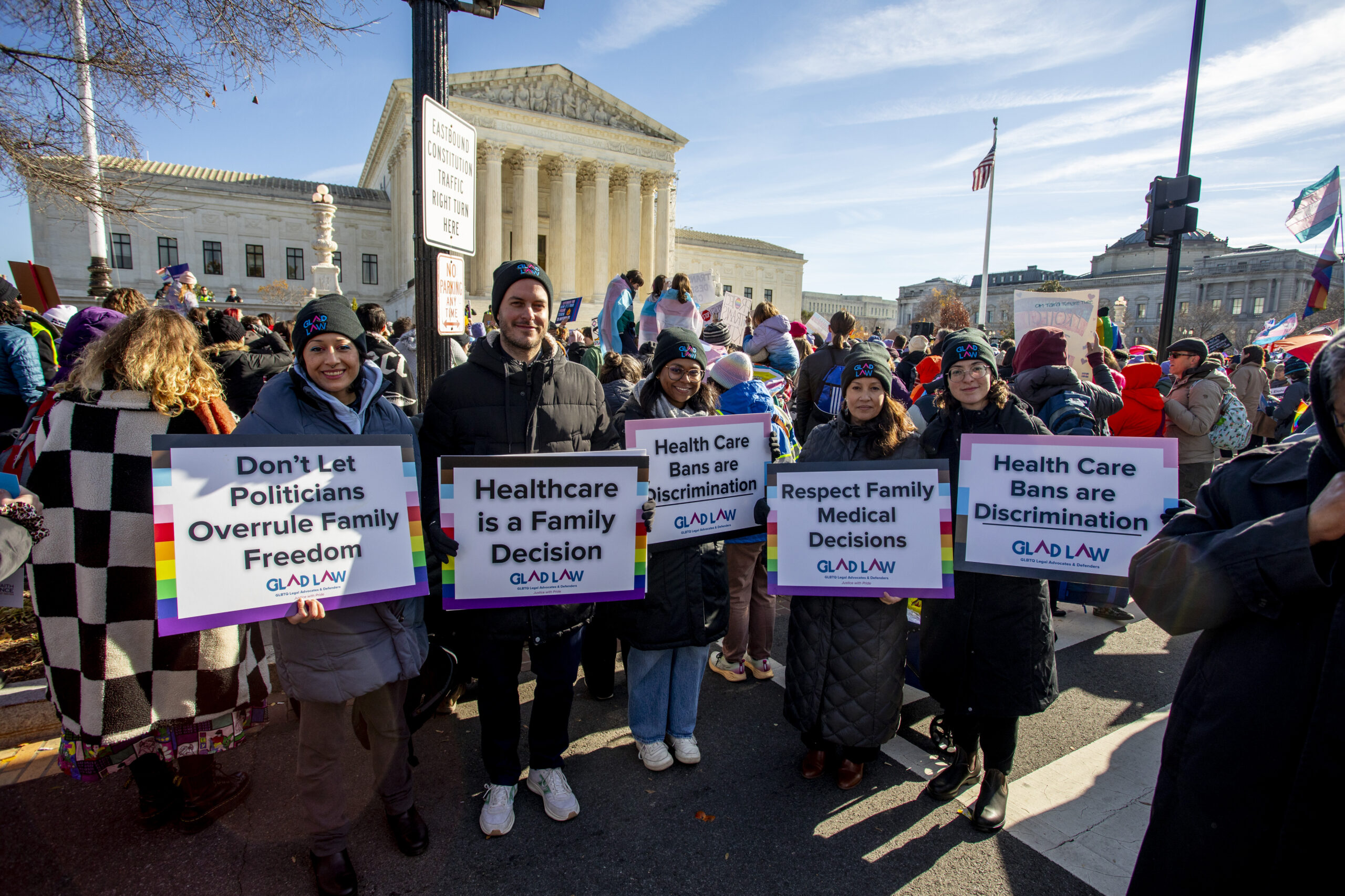
In January, GLAD Law and co-counsel Eve Hill of Brown, Goldstein & Levy successfully blocked a Department of Justice subpoena seeking confidential medical records from Children’s National Hospital’s Gender Development Program on behalf of eight families. A federal court rejected the government’s attempt to get sweeping personal information about transgender youth and their families, finding the subpoenas lacked any legitimate investigative purpose and instead appeared designed to intimidate patients and chill access to lawful health care.
Our action was one of several challenges to subpoenas the administration issued last year. Federal courts ruled in favor of each challenge, with one judge observing that the government’s demand for deeply private patient information carried “more than a whiff of ill intent.”
The administration has tried to circumvent these court losses with increasingly aggressive actions. The Department of Justice (DOJ) filed in the Northern District of Texas to enforce a subpoena against a hospital in Rhode Island, getting a nearly immediate order with no notice to the families whose medical records were at risk. Then the government escalated its abuse of power again by threatening criminal investigation. We are not backing down.
In early May, GLAD Law, joined by the National Center for LGBTQ Rights (NCLR) and Brown Goldstein & Levy LLP, filed a nationwide class action to stop the DOJ from enforcing a wave of nearly identical civil subpoenas issued to hospitals across the country. Later that month, GLAD Law and NCLR, with Rosen Bien Galvan & Grunfeld LLP, filed a third suit on behalf of six California families asking a federal court to stop DOJ from using a grand jury subpoena issued more than 1,500 miles away to seize their children’s confidential medical records from Lucile Packard Children’s Hospital at Stanford.
“The federal government has no business prying into Americans’ private medical records to serve a political agenda,” said Jennifer Levi, Senior Director of Transgender and Queer Rights. “It’s wrong to use the subpoena process as a political tool. It’s bad because it will keep transgender people from getting the medical care they need. And it’s bad for our public health system because it sends a message that no one’s medical information is private.”

GLAD Law is also fighting for transgender youth whose care has already been disrupted. In Connecticut, GLAD Law and attorney Kevin Barry represent 10 families challenging the abrupt termination of medically necessary care for transgender adolescents and young adults at Yale New Haven Health and Connecticut Children’s Medical Center. The hospitals stopped providing care to patients under 19 for no legally compelled reason and despite Connecticut’s strong nondiscrimination laws.
“These hospitals ignored their obligations under state law and put families in the awful position of having to rush to find alternative care or risk their children’s health,” said Staff Attorney Hannah Hussey. “Families have been forced to scramble for a new place to get the care their kids need while facing delayed treatment, increased health risks, financial burdens, and the trauma of losing trusted providers overnight.”
This action is currently pending before the state’s Commission on Human Rights and Opportunities, while allied organizations pursue similar litigation in other states.
We are also in federal court challenging the abrupt reversal of Department of Defense policy after nearly a decade, to now prohibit military clinics and hospitals from providing continuing medical care for servicemembers’ transgender dependents, and prohibit TRICARE, the military insurance plan, from covering the costs of care for transgender youth and young adults, no matter where it is received.
“This is a sweeping reversal of military health policy and a betrayal of military families who have sacrificed for our country,” explained Staff Attorney Lisa Rodriguez-Ross. “When a service member is deployed and focused on the mission, they deserve to know their family is taken care of. These families give so much, and instead of honoring that sacrifice, this administration is stripping away the medical care their children desperately need. This is not support for our troops. It is abandonment. We are in court to hold the government to the promise it made to every family that answered the call to serve.”
Beyond the courtroom, GLAD Law also weighed in on a proposed federal rule from the Centers for Medicare and Medicaid Services that would strip all Medicare funding from any hospital providing medically necessary transgender health care to minors. GLAD Law, NCLR, and COLAGE filed formal comments urging withdrawal of the rule, arguing it is legally indefensible, medically unsound, and part of a broader effort to pressure hospitals into abandoning transgender patients by threatening their federal funding.
That proposal is part of a wide-ranging federal strategy that courts are also increasingly recognizing as unlawful overreach. In April, a federal judge blocked a directive from Health and Human Services Secretary Robert F. Kennedy Jr. that similarly sought to restrict transgender health care by threatening hospitals’ federal funding. The court blocked the directive and criticized the administration for exceeding its authority and attempting to impose sweeping restrictions on medical care through executive action rather than lawful rulemaking.
As these attacks continue, GLAD Law remains committed to defending the ability of transgender people to access safe, well-established medical care without political interference, fighting federal overreach, and holding states accountable for their obligations to ensure access to health care for all residents.
This story was originally published in the Summer 2026 GLAD Law Briefs newsletter. Read more.
 Español de México
 Português
 简体中文
 香港中文
 Français
 Tiếng Việt
 العربية
 Polski
 Русский
 Deutsch
 Kreyòl Ayisyen