
Connecticut Know Your Rights - Page 9 of 12 - GLAD Law
Skip Header to Content
GLAD Logo Skip Primary Navigation to Content

Blog

Imagine being at the hospital as your child is born and worrying they might not be able to go home with you if something were to happen to your partner who had given birth. Imagine not being able to pick your child up from daycare, or take them to see a doctor. Imagine something happening to your partner and child services seeking to take custody because your child has no other legal parent. These are all real concerns that new parents have when they are not legally recognized—and new parents have enough on their plate as it is in the best of circumstances.

“I was not his birth parent and I wasn’t able to put my name on his birth certificate before we left the hospital. A birth certificate is the first and sometimes only legal link that a parent has with his/her child. It is a very, very big deal. My partner and I took the exact same steps as our “straight” infertile friends in conceiving, but we were denied the ability to put both of our names on the birth certificate just on the basis of our sex alone.”

Access to legal parentage shouldn’t depend on a family’s economic means, on whether the parents are of the same gender or different genders, or on how that family is formed. But our state laws haven’t kept up with the different ways that we form our families, including using assisted reproductive technology or having children before or without getting married. Even in New England, where we benefit from robust anti-discrimination laws, there remain significant gaps in parentage laws that force parents to undergo time-consuming, expensive and invasive processes in order to protect their relationship with their children. Many of these laws haven’t been updated since the 1970s.

Using the Uniform Parentage Act of 2017 (UPA) as model legislation, GLAD Senior Staff Attorney Patience Crozier has been collaborating with other advocates to advance parentage law reform in Rhode Island, Massachusetts, Connecticut and New Hampshire. The UPA and the state-specific bills modeled on it update the laws’ understanding of family to reflect present-day reality and to ensure accessible and nondiscriminatory paths to establishing parentage. This includes ensuring that LGBTQ families using assisted reproduction have access to parentage through the Voluntary Acknowledgement of Parentage process, which enables parents to secure their legal relationships to their children immediately at birth and without going to court. These reforms resonate with so many in the LGBTQ community and beyond who simply seek equal and fair means to secure their parent-child relationships.

The Rhode Island Parentage Act (RIPA) had substantial momentum and support in the 2019 legislative session. The bill passed unanimously in the Senate and had considerable support in the House where it was also poised to pass until the Chief Judge of the Family Court intervened unexpectedly. Despite having been consulted for his input prior to the bill’s filing, the Chief Judge engaged only at the last minute to request further study. The House created a study commission that will convene this fall to review the RIPA and move these critically important reforms forward. As a community, Rhode Island is galvanized to move this legislation forward and to ensure all children and families have equal access to parentage. GLAD will participate on the study commission, and remains committed to this legislative effort, and to sharing the stories of families who have experienced the difficult and painful impact of outdated parentage laws.

Parents Sara and Anna experienced the effects of Rhode Island’s outdated law firsthand when they started their family. Their son, Eli, was conceived using assisted reproduction. Because they were unmarried, Sara, as the non-birth parent, had no presumed legal parental connection to Eli at birth, and no route to establish her parentage.

“I was not his birth parent and I wasn’t able to put my name on his birth certificate before we left the hospital, which I know, sounds like a formality but it is not. A birth certificate is the first and sometimes only legal link that a parent has with his/her child. It is a very, very big deal. My partner and I took the exact same steps as our “straight” infertile friends in conceiving, but we were denied the ability to put both of our names on the birth certificate just on the basis of our sex alone.”

It took 8 months for Sara to adopt her own son – an excruciatingly long time to be in legal limbo, particularly when it comes to your child. What’s more, during all those months, Sara and Anna were subjected to the lengthy, invasive, and at times arbitrary steps of the adoption process, including putting an ad in the paper to notify the anonymous sperm donor of the pending adoption, in case he wanted to challenge the termination of his “parental rights.”

Rhode Island LGBTQ parents aren’t alone in seeking legislation to protect their families. Maine and Vermont both have passed comprehensive parentage reform, but the rest of New England has a ways to go.

Though Massachusetts now allows same-gender parents to sign a VAP, there are still barriers to establishing legal parentage within the Commonwealth. The MA Parentage Act is a sensible update to MA law that ensures all children and families have equal access to establishing parentage, and corrects discrimination that exists in the current state law. A public hearing on the MPA took place in early September.

In Connecticut, a coalition is working on draft legislation to update the state’s parentage laws, and we are hopeful that legislation will be filed in 2020. Similar efforts are also underway in New Hampshire, where statutes do exist to protect children born through ART and surrogacy, but where gaps in the law still still exist.

Love makes families, but we all agree the law needs to protect them. Continuing to operate with outdated, decades-old statutes leaves some children and families unprotected. GLAD is committed to ensuring that all children and families have access to the fundamental protection of legal parentage.


Hartford Pride 2019

Come out and see us at Hartford Pride!

Visit their website here.

News

On May 24, the Trump Administration announced a new proposed rule that would change the interpretation of the Affordable Care Act’s nondiscrimination provision to no longer include LGBTQ people.

It is alarming that the Trump administration is leveling yet another attack on the rights of LGBTQ people.

But, there are a couple of important things to note:

First, this is only the announcement of a proposed rule change. Nothing is changing right now.

The next step is a required period for public comment, which means we can all weigh in with our concerns about this proposal, and we encourage you to do so. We won’t know for sure what the final rule will look like until that public comment period is over.

If you’d like to take action, visit www.protecttranshealth.org to add your comment on why you oppose this proposed rule.

Second, no matter what the final rule says, the Trump administration cannot change the law on a whim.

Federal law has been interpreted by multiple federal courts to prohibit discrimination against LGBTQ people, in cases that apply in the health care context. Those decisions are controlling; the meaning and scope of federal protections ultimately turns on federal court interpretation, not that of the administration.

We also have strong state laws and regulations across New England that protect you from discrimination and protect your right to access health care. The proposed federal rule change does not alter those state laws. Contact us at www.GLADAnswers.org if you need more information.

The bottom line is that nothing is changing right now, and you still have rights to nondiscriminatory health care – but the Trump administration is working to make it harder for you to enforce those rights.

GLAD will be closely monitoring developments, and if you think you are being treated differently, or are experiencing discrimination, please contact us right away.

Access to HIV Prevention for Connecticut Youth

Victory! In July 2019, Governor Ned Lamont signed the bill into law.

GLAD strongly supports House Bill 6540, which would ensure that populations at risk for HIV have direct access to HIV PrEP and can avoid the currently incurable and life-altering consequences of HIV infection.

Young people are at especially high risk for HIV, and particularly gay and bisexual men of color.

Physicians must have the tools they need to help reduce the unacceptable racial disparities in PrEP utilization. Ensuring that physicians can prescribe PrEP when a youth is at risk for HIV, regardless of parental consent, will facilitate this critical public health goal.

We now have remarkably successful tools to keep youth safe, but doctors have been hampered from using this ground-breaking technology when minors do not have parental consent. We support the passage of House Bill 6540 to protect Connecticut’s youth.

Click here for a fact sheet about H.B. 6540: An Act Concerning the Prevention of HIV

Click here for a list of members of the Connecticut General Assembly’s Public Health Committee.

Connecticut Paid Family and Medical Leave S.B. 1 AND H.B. 5003 – 2019

GLAD supports partners Connecticut Women’s Education and Legal Fund, Planned Parenthood Connecticut, CT Working Families, and others in advocating for paid family and medical leave in Connecticut.

S.B. 1: An Act Concerning Paid Family and Medical Leave and H.B. 5003: An Act Implementing a Paid Family and Medical Leave Program would create and implement a comprehensive, statewide system of paid family and medical leave for workers who need time to care for themselves or a loved one or to welcome a child.

This legislation would promote the economic security and stability of all workers in Connecticut, including LGBTQ individuals and their loved ones.

GLAD Attorney Patience Crozier submitted testimony February 14, 2019, on GLAD’s support for the bills, their importance to the LGBTQ community, and the need to have an inclusive definition of family in Paid Family Leave programs.

On March 11, 2019, GLAD Senior Staff Attorney Patience Crozier submitted testimony regarding the Governor’s S.B. No. 881, An Act Establishing a Paid Family and Medical Leave Program, to urge the Labor and Public Employees Committee to ensure that there is an inclusive definition of family member as provided in S.B. 1 and H.B. 5003. Although GLAD supports action on this important economic justice issue, GLAD cannot support S.B. No. 881 unless it includes a fair and inclusive definition of family member which is not currently in this bill.

Celebrate 10 Years of CT Marriage Equality!

couple cheering in NYT headline saying "Gay Marriages Begin in Connecticut" by Lisa Foderaro, November 12, 2006, juxtaposed with LOVE MAKES A FAMILY sign with hands and hearts

Join us for a celebration of the 10th anniversary of marriage equality in Connecticut! Thanks to the hard work of thousands and thousands of people across our state that combined Love Makes a Family’s grassroots public advocacy and GLAD’s precedent-setting state supreme court victory in Kerrigan v. DPH, Connecticut was one of the earliest states to win the freedom to marry, and the first to say civil unions weren’t equality. Come and toast that victory, see old friends, and hear about new efforts that are underway to continue the campaign for legal and lived equality for the LGBTQ+ community.

Event is free and open to all! RSVP here.

News

Response to New York Times Report of Trump Administration’s Latest Move Against Transgender People

Statement of GLAD Transgender Rights Project Director Jennifer Levi

Today’s New York Times report that the Trump Administration is considering a proposal to define the word “sex” for legal purposes in a way that deliberately excludes transgender people is one more example of this administration’s disregard of human rights and its heartless political strategy of attacking the most vulnerable among us.

The reactionary policies of this administration have caused and will cause too many to suffer. But staying focused on the changes that our community, friends, and allies have so bravely brought about through our advocacy, our words, and our deeds, sustains me.  It informs my firm belief that the callousness of this administration is an aberration. We will persist, justice will win out, and this challenging moment will not define our country’s future.

This reported move is in conflict with the approach of both federal and state courts and government agencies in interpreting laws prohibiting sex discrimination. Even though the administration is working hard to delegitimize the federal judiciary upon which so many civil rights advancements have depended, we know that justice means justice for all.  GLAD will never back down from pursuing protections and challenging unconstitutional laws and policies in the courts. 

But just as importantly, the ideology being pushed by this administration is contrary to the beliefs and vision of countless leaders in education, business, medical and scientific communities, and among political leaders who have been willing to work across the aisle when rights and safety have been at stake.  It also stands in stark contrast with the lives and experience of transgender people, our families, friends, neighbors and coworkers, all across this great nation.

The bottom line is that this administration has a transparent, callous, political agenda – and it is willing to undermine our most fundamental institutions to pursue it. We have seen this at work everywhere from the military – where Trump continues to pursue his ban on transgender troops despite its proven negative impact on military readiness and vocal opposition from military leaders – to the arenas of education, employment, and healthcare. It is a toxic agenda, dangerous to us all.

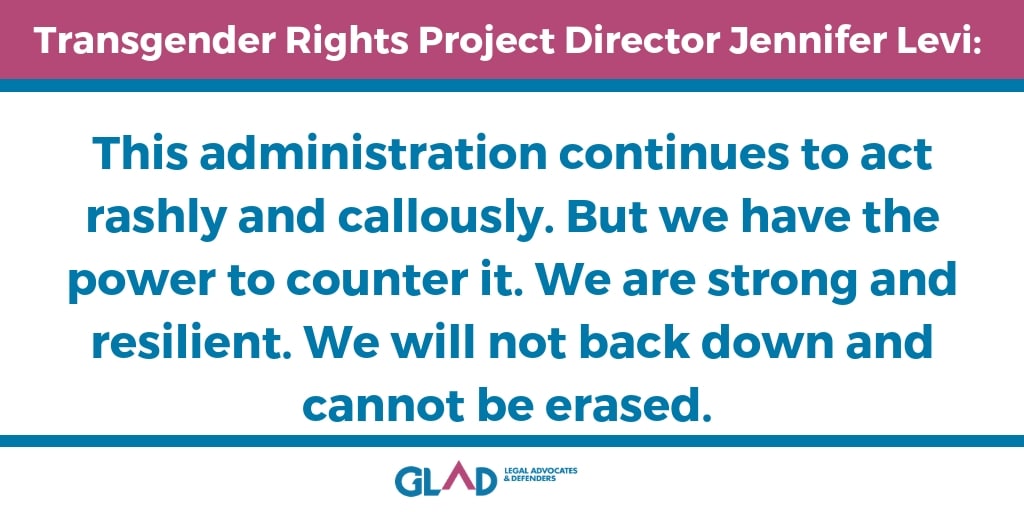
This administration continues to act rashly and in mean-spirited ways. But we have the power to counter it. We are strong and resilient. We will not back down and cannot be erased. We will continue telling the truth about our lives, treating one another with compassion, and fighting for justice. It is imperative that we act now, with our collective power, to stand up for what is right. We have an opportunity on November 6 to voice our values, to support candidates who believe in fairness, and reject those who use human beings as political pawns.

In Massachusetts, we face a critical vote – one that offers the chance to affirm the dignity and humanity of transgender people and to uphold the value of treating one another with respect. How Massachusetts votes on Question 3 will impact the direction of our nation. I am hopeful that the people in my home state will vote Yes on 3 to preserve the transgender civil rights law which we fought so long and so hard to pass. I am optimistic that we will demonstrate, once again, that the cruel agenda of a few does not reflect the will of We, the People.

The reactionary policies of this administration have caused and will cause too many to suffer. But staying focused on the changes that our community, friends, and allies have so bravely brought about through our advocacy, our words, and our deeds, sustains me.  It informs my firm belief that the callousness of this administration is an aberration. We will persist, justice will win out, and this challenging moment will not define our country’s future.

Blog

For the first time in our movement history, a stand-alone transgender non-discrimination bill passed and was signed in a Republican-controlled state. This will serve as a model for the rest of the nation, as we look to the fights ahead to protect and defend fairness and equality.

Last week, Governor Sununu of New Hampshire signed HB 1319, the bill that will protect transgender people across the state from discrimination in employment, housing, and public places. With the governor’s signature, New Hampshire became the sixth and final New England state to ensure transgender people have the security to live and work free from discrimination, just like everyone else. For the first time in our movement history, a stand-alone transgender non-discrimination bill passed and was signed in a Republican-controlled state.

This moment has been ten years in the making in the Granite State, and is a critical milestone in GLAD’s work advancing full equality across the region.

I remember the day NH Representative Ed Butler called me to say he wanted to introduce a bill protecting transgender people from discrimination. It was 2008 and GLAD had been building momentum for LGBTQ equality after securing legislative wins for non-discrimination protections across New England. By then, all six states had already adopted sexual orientation protections, and Rhode Island, Maine and Vermont had added gender identity to state non-discrimination laws. Connecticut would add gender identity to its non-discrimination laws in 2011. Massachusetts passed gender identity non-discrimination protections in employment, credit, and housing that year, and in 2016 passed transgender protections in public accommodations.

Without hesitation, I said, “Let’s do it.”

In 2009 we introduced the first incarnation of the transgender non-discrimination bill to the legislature, where it passed the House by one vote. In those early days of organizing, we worked with a small but passionate group of six people from the transgender community to testify before the Senate committee. The day the bill went to the Senate for a vote, marriage equality was also on the calendar. We won the freedom to marry that day. But the Senate swiftly killed the transgender non-discrimination bill.

That moment was a rallying cry, and the seed of grassroots community organizing was planted.

GLAD worked with Transgender NH, an organization for and by the transgender community, to lay the building blocks for winning statewide gender identity non-discrimination protections. Together, we started building relationships and supporting leaders within the community, like longtime advocate Gerri Cannon. We provided legal expertise and resources to develop a public education campaign and share the experiences of transgender people across the state in storybooks, pictures, and videos.

This was the foundation of GLAD’s strong, sustained investment and relationship-building across New Hampshire, which led to smaller yet impactful victories, including updating the state’s Department of Motor Vehicles policy for gender marker changes on driver’s licenses and ending the discriminatory exclusion from Medicaid coverage of gender transition-related surgeries.

This moment has been ten years in the making in the Granite State, and is a critical milestone in GLAD’s work advancing full equality across the region.

By 2016 New Hampshire was the only New England state without any law explicitly ensuring fair and equal treatment of transgender people. GLAD, along with Freedom for All Americans, helped form the Freedom New Hampshire coalition, a bipartisan coalition dedicated to growing support for HB 1319, the bill to add gender identity to state non-discrimination law, sponsored by Representative Butler.

This new campaign, also comprised of Transgender NH, ACLU of NH, Rights & Democracy, and the Human Rights Campaign, was a shot of adrenaline for our movement, fueled by transgender community members and their families, and led by campaign manager Linds Jakows, a proud nonbinary person. The grassroots public education campaign driven by Freedom New Hampshire garnered an unprecedented groundswell of bipartisan support statewide for transgender equality.

It was during the legislative hearings this year that I realized just how much the momentum for equality had grown. Hundreds of supporters – legislators, local and state officials, and the transgender community, their families, and allies – packed the Statehouse during the House and Senate hearings, and provided over twelve hours of powerful testimony.

Thanks to the strategic, organized, and persistent work of transgender community members, who are the real champions of this victory, a stand-alone transgender non-discrimination bill passed and was signed in a Republican-controlled state – for the first time in our movement history. I know this will serve as a model for the rest of the nation, as we look to the fights ahead to protect and defend fairness and equality, including in Massachusetts, where we’re fighting to uphold basic protections for transgender people at the ballot box this November.

With HB 1319 signed into law, all six New England states now have full nondiscrimination protections for LGBTQ people. GLAD is proud to have worked on the ground with communities across the region to advance equality. There is still so much more we can achieve. But our forty-years’ work building the foundation for these victories has prepared us for the fight ahead to protect these rights, and ensure a future of equality and justice for all in New England, and across the country.

News

On May 3, the Connecticut legislature passed SB13 An Act Concerning Fair Treatment of Incarcerated Persons, which includes some of the strongest protections in the country for transgender people who are incarcerated.

The updated law will ensure that transgender people are treated consistent with their gender identity including with regard to strip searches and access to clothing, commissary items and educational materials, as well as housing based on their recognized gender.

Advocating for fairer treatment of people who are incarcerated, through legislation like SB13 as well as litigation, is a priority for GLAD’s Transgender Rights Project. Transgender individuals are among the most vulnerable people within our systems of incarceration, facing daily harassment, humiliation, degradation, and abuse. The legislators and advocates, including the CT Equality coalition, who supported this change recognize that it is unacceptable for transgender people to face additional punishment simply for being who they are.

This victory is a step toward fairer treatment of transgender people who are incarcerated. We hope that other states will follow Connecticut’s lead on this critical issue.

GLAD is a supporting partner in CT Equality, a growing coalition of advocates and community organizations continuing the fight for equality and justice for LGBTQ+ people across Connecticut. On May 16, the coalition will host the CT Equality Convening, an opportunity for community members to talk about the issues they care about most and help shape the CT Equality advocacy agenda. RSVP here to join the conversation.

News

Statement of GLAD Senior Staff Attorney Patience Crozier

GLAD congratulates Connecticut for closing the Connecticut Training School, the last large youth prison in the state. This is an exciting and promising moment for Connecticut, particularly for the youth and advocates, including the Connecticut Juvenile Justice Alliance, who worked so hard for the facility’s closure. We know that youth prisons do not work. They particularly do not work for LGBTQ youth and for youth of color, who continue to be disproportionately represented in the juvenile justice system, and who suffer from high levels of harassment and abuse when incarcerated.

The decision to close this facility reflects evidence and understanding that we can meet youth needs for growth and development, and address public safety needs, with quality community-based programs and a focus on treatment and skill-building rather than incarceration.

Resources must be focused on diverting youth from entering the juvenile justice system, and providing care and services for youth in their communities. Closing the Training School is a momentous positive step, and we hope and expect the state will invest substantial resources in local communities to address the needs of youth, and to support youth and communities with a robust continuum of care.

Connecticut has shown strong leadership in closing its last youth prison, and has an opportunity to be a model for the region and the nation. We hope other states, including Maine where GLAD and other youth advocates are actively engaged in addressing serious issues at Long Creek Youth Development Center, will follow the example Connecticut has set.

en_USEnglish
Privacy Overview

This website uses cookies so that we can provide you with the best user experience possible. Cookie information is stored in your browser and performs functions such as recognizing you when you return to our website and helping our team to understand which sections of the website you find most interesting and useful.

To learn more, visit our privacy policy.