

Blog
June 9, 2026
The Legal Landscape for LGBTQ+ Youth Is Shifting. GLAD Law Is Meeting the Moment.
A series of court decisions and lawsuits is reshaping the legal landscape for LGBTQ+ youth and their families, putting longstanding protections in education and mental health care under strain. Amid intensifying attacks, GLAD Law is fighting to ensure LGBTQ+ young people can be healthy, safe, and supported in all areas of their lives, and full participants in their education.
The US Supreme Court weakened Colorado’s law prohibiting conversion therapy for minors in Chiles v. Salazar, raising questions about similar bans in 22 other states, Washington, DC, and other cities throughout the country. The Court ruled that Colorado went too far in regulating talk therapy, in violation of the First Amendment, and sent the case back to the lower courts.
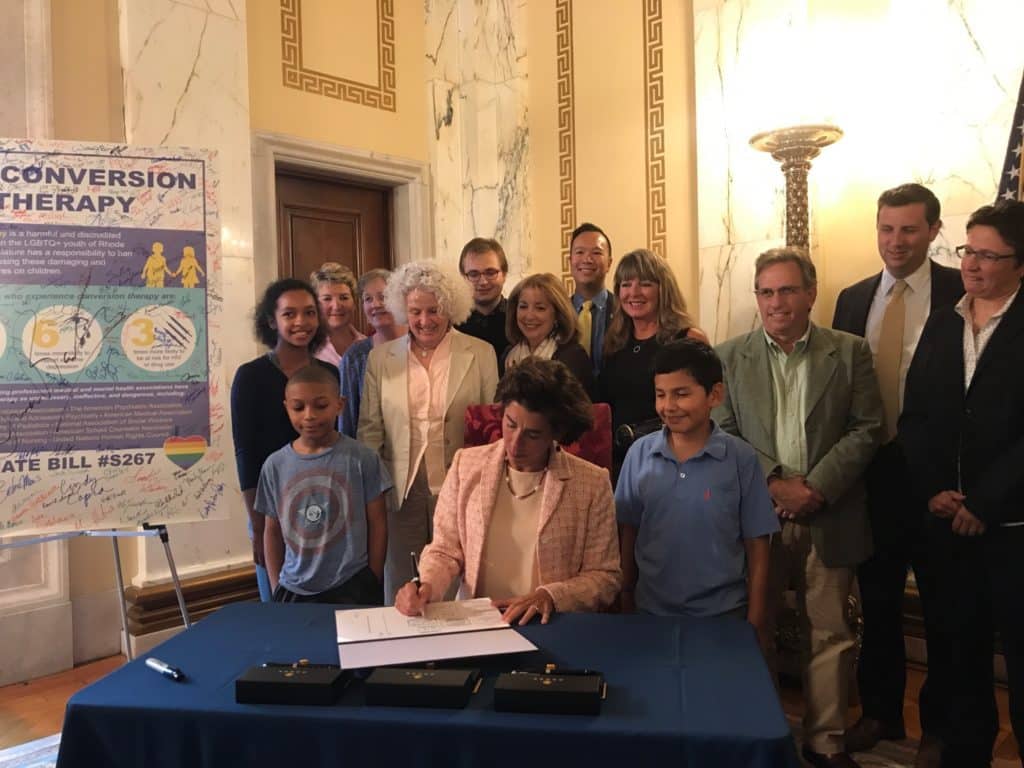
GLAD Law filed a friend-of-the-court brief in Chiles on behalf of eight conversion therapy survivors whose stories showed how the long-discredited practice fractures families and isolates young people from their religious communities, highlighting the lasting trauma conversion therapy inflicts on individuals, families, and entire communities.
The Court’s ruling was a blow to these survivors and others like them. Our community understands the harm caused by efforts to force us to deny or attempt to change who we are. But it’s not the end of the story.
GLAD Law Staff Attorney Sarah Austin explains three important things to remember, despite this decision: “First, conversion therapy remains a dangerous, discredited practice – the Supreme Court cannot change what science consistently shows. Second, the Court made clear that practitioners can still be held liable for medical malpractice and consumer fraud. Third, GLAD Law and our national partners are already developing new legislation that can withstand the Chiles decision so states can continue protecting young people from conversion therapy.”
Indeed, less than two months after the ruling, Colorado Governor Jared Polis signed a new conversion therapy ban designed to comply with the Chiles ruling’s reasoning about so-called “viewpoint neutrality” while preserving protections for LGBTQ+ youth.
At the same time, courts are weighing challenges to school policies that support LGBTQ+ students, particularly transgender and gender nonconforming youth. As opponents of LGBTQ+ equality increasingly target schools, educators, and health care providers, courts are issuing mixed decisions about how institutions can support LGBTQ+ young people.
In March, the Supreme Court issued a ruling in Mirabelli v. Bonta, a challenge to California’s policy barring school personnel from disclosing a student’s change of name or pronouns to parents. The Court allowed a lower court ruling against the policy to remain in effect while the case proceeds, signaling that the Court views blanket policies preventing conversations with parents as implicating parents’ constitutional rights.
Issued through the Court’s emergency, or “shadow,” docket without full briefing or oral argument, the ruling nonetheless carries significant weight nationwide. The Court also suggested that a student’s use of a different name or pronouns could implicate parental rights related to a child’s mental health and well-being, without clearly defining when schools must involve parents or how broadly that reasoning applies.
On the other hand, in April, the Court declined to review Foote v. Ludlow and Littlejohn v. School Board of Leon County, leaving in place lower court rulings upholding some discretion for schools supporting transgender students. In Foote, the Court preserved a western Massachusetts middle school policy requiring student consent before informing parents about changes to names or pronouns at school. In Littlejohn, the Justices let stand a ruling rejecting claims that Florida educators violated parents’ rights by excluding them from discussions about their child’s gender identity.
“Collectively, these decisions leave schools navigating an uncertain legal landscape,” said GLAD Law Senior Staff Attorney Chris Erchull. “The Court appears skeptical of policies that prohibit disclosure of information to parents. But schools can still maintain practices that give LGBTQ+ students space to understand themselves while at school and to initiate important conversations with their families safely and on their own timeline. Schools will need to make good-faith judgments in crafting policies that both foster partnership with parents and ensure a safe, supportive learning environment for all students – including LGBTQ+ students.”
GLAD Law is working with policymakers to craft durable protections for transgender and gender nonconforming students amid this uncertainty. Amidst an environment where school policy feels uncertain, we are also helping families secure individual education accommodations for children with gender dysphoria, a medical condition some transgender people experience, consistent with federal disability laws requiring schools to meet the needs of students with disabilities.
Developing new strategies is especially critical as the Supreme Court considers BPJ v. West Virginia and Little v. Hecox, cases that could impact how courts interpret sex discrimination protections for transgender students under Title IX. While a narrow but still harmful ruling could be limited to permitting states to categorically ban transgender girls from playing on girls’ sports teams, a broad ruling could have the potential to also roll back other protections for LGBTQ+ students.
The decision could also directly affect GLAD Law’s plaintiffs in Tirrell and Turmelle v. Edelblut, a challenge to New Hampshire’s blanket ban preventing transgender girls in grades 5-12 from playing school sports. When students are excluded from opportunities in sports solely because they are transgender, the message is that transgender people do not belong in our schools. We must use all the tools at our disposal to fight back.
These are deeply personal stakes for LGBTQ+ youth. Courts are determining whether students can safely confide in a trusted teacher or join their friends on the school soccer team – and whether schools can continue supporting LGBTQ+ youth without fear of political retaliation or litigation. GLAD Law is working alongside families, educators, and advocates to defend LGBTQ+ youth in the courts, secure practical protections in schools, and ensure young people and the adults who support them are not left to navigate these attacks alone.
LGBTQ+ Students, You (Still) Have Rights!
Despite recent legal shifts, LGBTQ+ students still have the right to equal treatment and protection from bullying and harassment at school under federal law and many state laws.
Unless the Supreme Court rules differently, Title IX currently requires schools to provide LGBTQ+ students with equal educational opportunities and still gives students and parents the ability to assert their rights to a discrimination-free school environment under federal law.
Additionally, 19 states across the country and D.C. have laws protecting the rights of LGBTQ+ students in schools and will investigate and enforce violations of those protections. GLAD Law Answers can help answer questions about the laws in your state.
If you or a student you know has experienced bullying or harassment at school because of being LGBTQ+, we want to connect with you. Please visit us online to learn more or confidentially share your experience.
This story was originally published in the Summer 2026 GLAD Law Briefs newsletter. Read more.
 Español de México
 Português
 简体中文
 香港中文
 Français
 Tiếng Việt
 العربية
 Polski
 Русский
 Deutsch
 Kreyòl Ayisyen